Jump to:
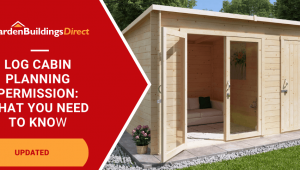
Thinking of investing in a log cabin for the garden soon? Though it often doesn’t require planning permission, there are circumstances where it might. Read on to find out whether planning permission applies to yours.
Note: This information applies to garden log cabins only. Different rules apply to residential log homes.
What Are the Requirements for Log Cabin Planning Permission in England?

Most garden log cabins fall under permitted development rights. Generally, they don’t need planning permission as long as they are within the size, height, and boundary limits. Now, if your log cabin is beyond these restrictions, you’ll need to apply to your Local Planning Authority (LPA).
If you need planning permission, it is best to prepare the following documents: proof of ownership, site plans, floor plans, application form, and any other documents your council requires. Always check with your LPA for their exact requirements, as this can vary.
How long does planning permission take?
Most householder planning applications are decided within 8 weeks. Bigger or more complicated applications may take a bit longer, up to 13 weeks. If your application isn’t approved, you’ve got options: tweak your plans and try again, or appeal the decision.
Your council can advise you on the next steps and what’s needed.
Do I Need Planning Permission for My Log Cabin?
Planning permission is not necessary if it meets the following criteria:
- Height near boundaries. Any part of the cabin within 2 m of a boundary must not exceed 2.5 m in total height. If the cabin sits more than 2 m from every boundary, the maximum overall height is 4 m for a dual-pitched roof (apex or reverse apex) and 3 m for any other roof type, including pent. In both cases the eaves — the lowest part of the roof — must not exceed 2.5 m.
- Single storey. The log cabin must be single-storey and can’t have verandas, balconies, or raised platforms over 0.3 m high.
- Garden coverage. The log cabin must cover no more than 50% of the total area around your original house. Moreover, it can’t be built in front of the principal elevation.
- Land already with planning permission. If your plot already has planning permission for a building, you may be exempt from these rules.
Our range of cabins meets permitted development rules, so you can build without the paperwork:

Where building regulations apply?
Log cabins over 15 m² fall under Building Regulations, not planning permission. These rules include concern for fire safety since log cabins are made of wood and can burn.
For instance, you have the structure right next to a fence or boundary, say, less than a metre away from your neighbour’s property. Building Regulations may require fire-resistant materials, extra spacing, or other measures to reduce risk.
Some of our log cabins need to follow these rules, especially if they’re very close to a boundary, which is quite common in smaller gardens. If your cabin is further from your neighbour, it’s less likely to be affected. Even so, check with the supplier or your local authority to ensure it meets the regulations.

When is planning permission needed?
Planning permission is needed for a garden cabin if it:
- Is intended for self-contained accommodation (e.g. a rental or separate living space) or commercial use.
- Is in a conservation area, a listed building, or another protected site.
- Involves significant changes to existing buildings, such as demolishing walls.
Building Regulations for Garden Log Cabins
Building Regulations might apply to your log cabin even if you don’t need planning permission. These rules include concern for fire safety since log cabins are made of wood and can burn.
Here’s the simplified checklist:

- Your cabin is made of a combustible material
- It’s over 15 m² internal floor area (so, anything over a 5×3 metre cabin)
- You’re placing it less than one metre from your property boundary (very likely, as people usually want buildings at the edges)
When all 3 of these criteria are met, you have to get approval under the Building Regulations.
To get approval, you may have to install fire-resistant materials, extra spacing, or other measures to reduce risk. The easiest way would be to build more than 1 metre from your boundary.
If your cabin is going to be affected, check with your local authority to see what you’ll need to do to comply with the law.
Cabins over 30 m² will always require building regulations approval.
If you plan to install electricity in a log cabin, these works have to satisfy Part P of the Building Regulations. The simplest way to achieve this is to hire a qualified and registered electrician to do it.
Round-up
It’s important to know the rules before building a log cabin. Most don’t require planning permission, but some do when they’re large, in a protected area, or for specific uses. Check in with your local council to ensure everything is in order.
Browse our range of log cabins for sale today. For guidance on choosing the right one, see our log cabin buying guide. Questions? Call us on 01909 768840—we’re happy to help.